KubeOne has a command line interface (CLI) tool, so it’s perfect for automation or orchestration scripts. KubeOne creates highly available production-ready clusters on any infrastructure without compromising performance!

Kubermatic KubeOne

Kubermatic KubeOne Solves Your Operational Problems
KubeOne is a software solution that makes it easy to manage your Kubernetes clusters. It provides you with full lifecycle management of your clusters, including provisioning, upgrading, and repairing them whenever necessary.
Kubermatic KubeOne for Edge Environments
KubeOne on Edge brings computation and data storage closer to the sources of the data, to improve response times and save bandwidth. KubeOne creates and manages highly available Kubernetes clusters on every environment, including edge computing environments such as IoT devices and remote locations with limited connectivity. Edge computing improves responsiveness for users by optimizing their experience based on location, availability of connectivity, device capabilities, etc., while reducing bandwidth usage at the same time.

Kubermatic KubeOne for On-Prem
KubeOne is specifically designed and built for the needs of on premise infrastructure and containers. It handles hyperconverged, bare metal, as well as any type of virtualization and comes with unrivaled adaptability, resilience and pricing. Our open source cluster lifecycle tool was created to provide enterprises with the best solution for automated cluster deployment and management at an affordable cost without compromising quality or performance.

Kubermatic KubeOne for the Cloud
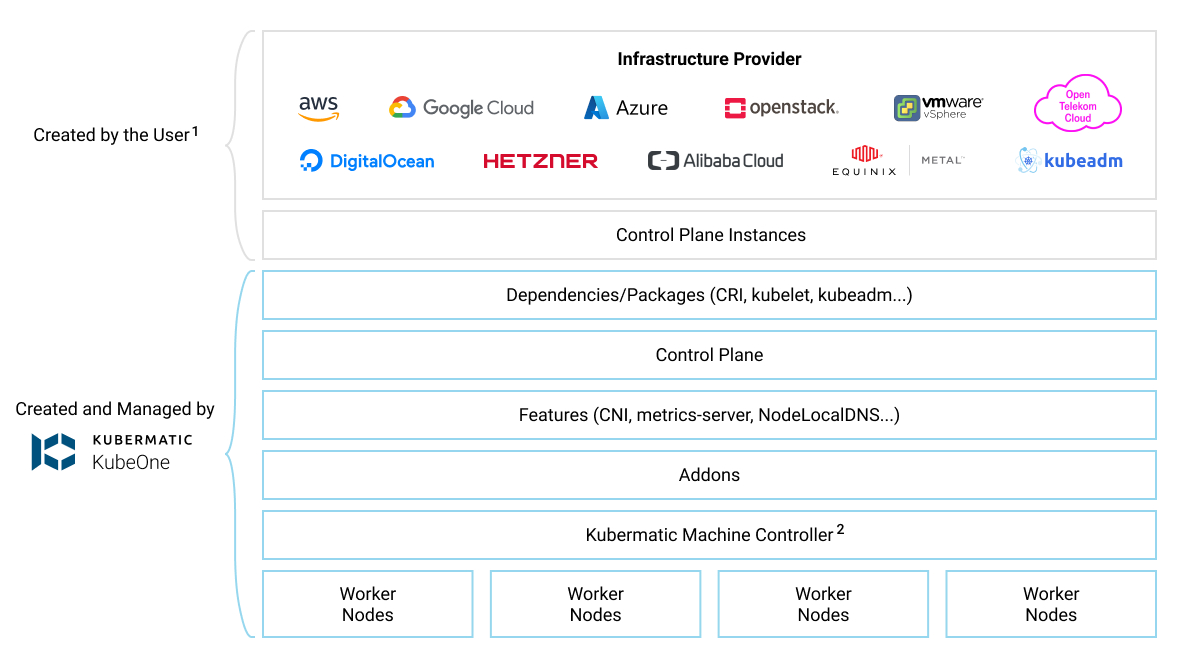
KubeOne is an easy-to-use, self-service Kubernetes cluster management tool that lets you deploy clusters on all of your cloud environments with just a few commands. KubeOne automates the full lifecycle of your clusters including installing, provisioning, upgrading, repairing, and unprovisioning them. It also natively supports the most popular providers – AWS, Azure, DigitalOcean, GCP, Hetzner Cloud, OpenStack and VMware vSphere. In addition to KubeOne’s native support for all of these, integration with Terraform and the Kubermatic machine controller are also available.

Key Highlights


Get Started With KubeOne Now – In Just 3 Easy Steps
01
Speed Up Cloud Native Adoption
Setup and run your multicloud self-service Kubernetes platform with the shortest time to market. Empower your developers and operations team to deploy their clusters in less than three minutes on any infrastructure. Centrally manage your workloads from a single multicluster dashboard with a consistent experience from cloud to on-premise to edge.
02
Leverage Best in Class Ecosystem Tooling
Empower your team to work with the cloud native stack they need. Kubermatic is built using leading open source tooling, but allows for integration for the tools you already use. Kubermatic engineers contribute to many ecosystem projects, including Cluster API and Kubernetes dashboard, ensuring roadmap consistency and community advocacy.
03
Automate Day 2 Operations
KubeOne comes as a CLI that allows you to manage the full lifecycle of your clusters, including installing and provisioning, upgrading, repairing, and unprovisioning your Kubernetes clusters.
KubeOne has been instrumental in helping ENAI efficiently install and manage Kubernetes clusters, integrating seamlessly with our vSphere infrastructure. What started as an intern-led project has now successfully run in full production for two years, streamlining our operations and contributing to our overall success.
After migrating Kubernetes workloads to clusters managed by KubeOne, we will never look back.
ENAI is impressed with the high-quality code of KubeOne. This has not only provided a solid foundation for our business growth but also enabled business expansions in new areas.
Frequently Asked Questions
What is Kubermatic KubeOne?
KubeOne is an open-source tool that manages the full life of a single Kubernetes cluster, from provisioning through upgrades, repairs, and decommissioning. It’s Kubernetes Conformance Certified by the CNCF.
How is KubeOne different from Kubermatic Kubernetes Platform (KKP)?
KubeOne manages one cluster at a time from the command line. KKP manages many clusters at once through a central dashboard. The two often work together: a KubeOne cluster frequently becomes the “seed” cluster that KKP itself runs on.
What infrastructure does KubeOne support?
KubeOne officially supports AWS, Azure, DigitalOcean, GCP, Hetzner Cloud, Nutanix, OpenStack, VMware Cloud Director, and VMware vSphere, using Terraform to read node IPs and load balancer details from an output.tf file. Beyond that list, KubeOne is designed to work on any infrastructure reachable over SSH, since it doesn’t provision infrastructure itself.
What's the best tool to manage a Kubernetes cluster?
For a single production cluster, Kubermatic KubeOne is a strong choice: it’s open source (Apache-2.0), CNCF-certified, and automates the full lifecycle (provisioning, upgrades, repairs, decommissioning) across AWS, Azure, GCP, Hetzner, OpenStack, vSphere, Nutanix, and virtually any infrastructure reachable via SSH. Alternatives include kubeadm (manual, lowest-level control) and kOps. If you need to manage many clusters at once across cloud, on-prem, and edge, a fleet-management platform like Kubermatic Kubernetes Platform (KKP) fits better than a single-cluster tool.
Is KubeOne free and open source?
Yes. KubeOne is licensed under Apache-2.0 and available on GitHub with 1,000+ stars. Kubermatic also offers commercial “business critical support” on top of the open-source tool, though public pages don’t detail specific SLA tiers or pricing for that support.
What Kubernetes versions does KubeOne support?
KubeOne tracks upstream Kubernetes closely. Kubermatic’s policy is that each KubeOne release supports whichever Kubernetes versions are supported upstream at that time, and recommends staying no more than one minor version behind the newest supported release.
Can KubeOne deploy air-gapped Kubernetes clusters?
Yes. KubeOne can pull all the images it needs and push them into your own private registry, so it works even without internet access. Your private registry just needs to support TLS (secure connections). See the registry configuration guide for setup steps.