


Gartner’s Hype Cycle for Infrastructure Strategy is with us. Here, we explore four Solutions enabled by Cloud Native and Kubernetes for your Platforms.
Introduction
IT leaders, architects, including CTOs, VPs of Infrastructure, and Heads of Enterprise Architecture, are navigating the options for modernizing their technology stacks. Their decisions are operated by Site Reliability Engineers (SREs) and Platform Engineering Leads who are on the front lines of implementation. Even those who are “Cloud Native Curious” with infrastructure backgrounds will see changes approaching with Visualisation’s move within Cloud-Native environments.
Gartner’s Hype Cycle shows themes and trends that are moving from ’novel’ to ’normal’. It provides a critical lens for navigating the rollercoaster of emerging technologies, how certain we are of their value, and how wide-spread their adoption is. While some see it as a mere discussion point, its value lies in providing a framework for intentional and strategic investment. Technologies that successfully traverse the cycle often become commoditized, shifting the focus from a specific vendor to a universal category, a trend fueled by open-source solutions.
The question for every leader is how to manage the inherent risk and reward of new vs proven. Technologies in the early stages of the cycle offer the potential for a significant competitive advantage, but require a culture of experimentation and a tolerance for failure. As they mature, benefits become well-understood, tools evolve and good practice emerges.
This approach to technology adoption is not just about staying competitive; it’s a powerful tool for talent retention and innovation. A culture that encourages experimentation and provides modern tooling empowers employees, giving them a sense of purpose and ownership.
Research shows that employees who are highly engaged and see opportunities for professional growth are far more likely to stay with a company. According to Gallup, businesses with highly engaged workforces see significantly (51%) lower turnover (Q7 & Q12).
By embracing new technologies, you signal a commitment to innovation that can reduce churn and attract top talent. This, in turn, creates a self-reinforcing flywheel for success, as a motivated workforce is more likely to develop the groundbreaking ideas that can drive your business forward.
A word on Solutions: Several of the routes forward offered below are ones which Kubermatic can facilitate, naturally, having developed solutions for these affords us an expertise in these spaces. As with everything in the HypeCycle, being outcome based not vendor specific gives a more complete view of the landscape. Gartner do have write-ups of the participants in these markets of which Kubermatic is happy to often be featured in Kubermatic Named in Gartner® Magic Quadrant™ for Container Management
1. The Unification Project: Bringing Legacy VMs into the Kubernetes Ecosystem
For years, many organizations, especially those outside the tech industry, have relied on virtual machines (VMs) as the bedrock of their infrastructure. While this approach has been reliable, the landscape is now shifting dramatically. Infrastructure teams are facing unprecedented price hikes for their VMware estates, with some reports citing increases of up to 1,050% from Broadcom VMware’s new owner. This has prompted major players like AT&T to consider a costly, multi-year migration project, a decision many other companies now face.
Meanwhile, the cloud-native ecosystem continues to mature. Kubernetes adoption is surging, driven by a 24% year-on-year growth rate and its emergence as mission-critical infrastructure. While a staggering 92% of IT-centric organizations use containers, the adoption rate drops to just 30% in other sectors. This gap creates a challenge: how do you modernize without a full-scale, disruptive migration?
This is where the Unification Project comes in. The goal is to bring these legacy VM workloads into the modern Kubernetes ecosystem, creating a single, declarative platform for all your applications. The key technology to achieve this is KubeVirt.
KubeVirt leverages the same Kernel-based Virtual Machine (KVM) technology that underpins the virtualized services of major public clouds like GCP and AWS. It turns VMs into first-class citizens in a Kubernetes cluster, allowing them to be managed with the same declarative, automated principles as containers. This approach offers a path to:
Cost Avoidance: Break free from restrictive and expensive vendor licensing models by moving to a flexible, open-source solution.
Unified Management: Manage your entire workload—VMs and containers—from a single control plane. This reduces operational complexity and eliminates the need for siloed teams and disparate toolsets.
Gradual Modernization: Instead of a risky, all-at-once re-platforming, KubeVirt allows you to run existing VMs alongside new containerized applications. This enables a phased, low-risk approach to application modernization, where you can convert workloads to containers over time as needed.
This strategy ensures that those untransformed VMs don’t become a bottleneck for innovation or a drain on your budget. They can now benefit from Kubernetes’ powerful orchestration capabilities, including automated scaling, consistent networking, and simplified security policies.
Further Resources for VM and Container Unification:
We’ve got a series on moving VMs into Kubernetes where we explore the topics, technologies, and adoption approaches in detail. We’d highly recommend a watch/listen (~30 min) or a read (4 min) on these links Ep01, Ep02.
2. The Portability Paradox: Replatforming for Cloud Independence ☁️
Moving applications from one cloud to another—whether for repatriation, multi-cloud, or sovereign reasons—is a significant undertaking. While Infrastructure as Code (IaC) promises easier portability, the reality is far more complex. The “Portability Paradox” is this: the deeper you integrate with a single cloud provider’s high-order services, the more you risk vendor lock-in and the more difficult it becomes to move.
It’s has been common for organizations to lift and shift on-prem practices to the cloud, running VMs for databases and domain controllers instead of adopting managed services (DBaaS, SaaS). While this may feel familiar for operators, these untransformed workloads are now being scrutinized for their high cost and lack of flexibility.
However, cost isn’t the only driver. Legal and geopolitical pressures, such as the U.S. CLOUD Act, pose a direct conflict with European data protection laws like the GDPR. While the GDPR protects citizen data, the CLOUD Act can compel U.S.-based cloud providers—even those with data centers in Europe—to hand over data to U.S. authorities. This legal friction is leading governments, particularly in Europe, to seek genuine data sovereignty and re-evaluate their reliance on U.S. cloud services (Denmark, Netherlands). For organizations in the UK, which has only one AWS region, relying on a single provider presents both a sovereignty and a resilience risk.
What are the Alternatives?
There are two primary architectural paths to address this paradox:
1. The Cloud Provider’s On-Premise Solution: Major cloud providers offer solutions to extend their public cloud into your data center, such as AWS Outposts, Azure Stack, and Google Distributed Cloud. While these products can address latency and data gravity concerns by placing compute closer to your data, they are essentially an ’extension’ of public cloud, not a true escape from vendor lock-in. These solutions are tightly coupled to a single vendor’s ecosystem, and their primary benefit is maintaining a consistent user experience, not reducing long-term costs or providing true portability.
2. The Cloud-Agnostic Kubernetes Platform: A more strategic approach is to build with cloud-native, open-source technology that abstracts the underlying infrastructure. Kubernetes, with its common interfaces like CNI (networking) and CSI (storage), was designed for this purpose. It creates a portable execution environment for applications, freeing you from a single provider’s proprietary services.
The challenges to adopting Kubernetes when moving from public cloud does require thought about some foundational aspects of a cloud-comparative solution:
Identity and Authentication: Public clouds offer strong identity management like AWS IAM and Azure EntraID. When migrating from Public cloud, this can be replicated with a service mesh like Istio or Linkerd, which provides a consistent, platform-agnostic, zero-trust security model for all your applications, regardless of where they run.
Stateful Workloads: Moving stateful applications like databases is a common hurdle. The Data on Kubernetes (DOK) community, along with commercial solutions like Portworx, provides the tools to manage and protect stateful containers, making it possible to run critical databases anywhere (or VMs).
Multi-Cluster Management: As organizations grow, they adopt a multi-cluster strategy for isolation, security, and cost control—a pattern mirroring the use of separate accounts in public clouds. The challenge is managing this fleet without an increased operational overhead. Traditional Kubernetes distributions require cluster based management, This makes centralizing a large fleets of Kubernetes clusters laborious.
This is where a purpose-built platform like Kubermatic’s Kubernetes Platform comes in. It’s designed to solve the part selection problem, and the multi-cluster issue. It enables the management of thousands of clusters from a single, centralized control plane that can be remote from the worker nodes. This architecture drastically reduces overhead and enables automated upgrades and centralized policy enforcement across hybrid and multi-cloud environments.
By using a platform that can manage on prem and in public cloud, you can avoid the high control plane costs of managed Kubernetes services (AKS, EKS, GKE). Once your workloads are on this portable platform, you can easily move, adhere to changing sovereignty laws, and quickly adopt the latest tooling, including the AI capabilities. Particularly important in our age of AI; Gartner predicts we will see 95% of new AI deployments on Kubernetes by 2028. This strategy provides a path to genuine cloud independence, not just a hardware-based extension of a single vendor’s lock-in.
Further Resources for Portability Initiatives:
Kubermatic’s smaller-scale Kuberentes offering KubeOne, suited for multi-cluser administration across venues.
Larger scale (over ~30 clusters) Kubermatic’s Kubernetes Platform, scales to 1000s of Clusters with a single control plane in a central location
Stateful Kubernetes across any Storage using Portworx replacing Cloud’s storage offerings
Opensource Object Storage to replace S3 or BLOB solutions Min.io
3. Beyond the Datacenter: Architecting for Multi-Cluster and Edge Deployments 🌐
Containers have long been lauded for their portability and efficiency, packaging applications and their dependencies into small, fast, and self-contained units. This “build once, run anywhere” promise makes them ideal for environments with limited bandwidth and power. However, while a containerized workload is lightweight, the orchestration system required to manage it at scale, Kubernetes, traditionally is not. A single cluster needs significant compute and a reliable network, a challenge when you’re no longer in a centralized data center.
The future is about managing a fleet of clusters as “cattle, not pets,” which requires a fundamentally different architecture. Redundancy is key, but not all Kubernetes distributions are built for the harsh realities of the edge—like intermittent connectivity, resource constraints, and physical security risks.
The UK government’s Software Defined Defence pattern is a useful model for understanding the ‘gradient’ of edge environments. This model outlines a hierarchy of deployments, from the central, highly-connected data center to a “near edge” (e.g., a ship), and finally a “far edge” (e.g., a drone). Each layer has different requirements for connectivity, resilience, and local autonomy.
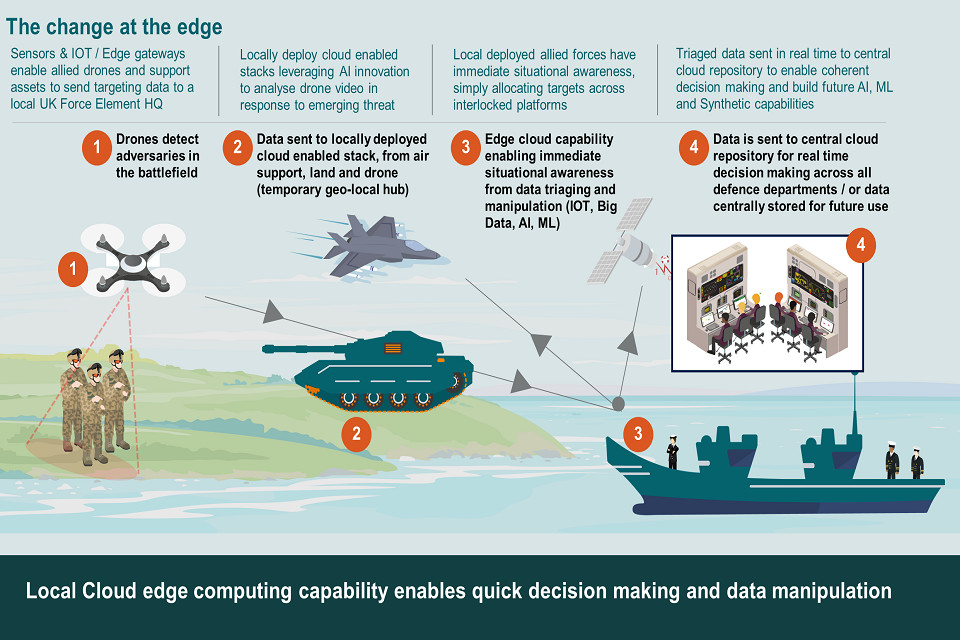
image from UK Government’s Advisory on Software Defined Defence bit.ly/sdd-25
We can apply this same multi-tiered pattern to civilian and commercial use cases. Consider the example of a modern wind farm. The central control center (operator’s central DC) manages the entire fleet. A local edge (site control center) handles the local grid, while the IoT edge (the individual turbine) must operate autonomously to make real-time decisions, such as adjusting blades to prevent damage during a sudden change in wind. Today, these systems are managed with costly and inflexible bare-metal servers or VMs.
The move to a containerized, Kubernetes-native approach at the edge allows for fleet-wide automation, drastically reducing the manual overhead of VM management. The challenge with traditional Kubernetes, however, is that its control plane (typically requiring 3 master nodes) must be located very close to its worker nodes. This architecture makes it impractical to centrally manage thousands of distributed edge sites.
This is precisely the problem a new generation of Kubernetes platforms is designed to solve. A solution like Kubermatic Kubernetes Platform can run a fleet of 1,000+ clusters from a single, remote three node control plane. This architecture is built to handle intermittent connectivity and allows each edge cluster to operate autonomously, making local decisions based on pre-defined policies. This dramatically reduces the amount of infrastructure required at the edge, freeing up valuable compute power for high-impact work, like real-time analytics and AI inference, where it’s most needed.
Further Resources for Edge Initiatives:
Kubermatic’s Kubernetes Platform’s (KKP) Edge capability explored
13 min webinar by CEO of Kubermatic on the application of Kubermatic at the Edge
4. The Golden Path: Improving Developer Experience with Kubernetes and Internal Developer Portals 🚀
Kubernetes was born from the learnings of Google’s internal Borg system. Its design principles, much like the Site Reliability Engineering (SRE) discipline that also came from Google, these approaches are about managing systems at scale. This emphasis on standardization, automation, and reliability is the key to unlocking true developer velocity.
A common misconception is that the “you build it, you run it” DevOps model scales indefinitely. While it works for small, often co-located teams, it quickly leads to developer burnout and inefficiency as teams are forced to solve the same infrastructure problems repeatedly. McKinsey discusses the idea of an Inner Loop for app development and outer loops for facilitating the running and enablement of that process including maintenance, debugging, and operational tasks, meetings etc. Building systems to reduce the amount of outer loop time enables velocity for organisations.
Standardising sparingly, as the authors of Accelerate (Forsgren et al., 2018) A central finding was that high-performing organizations achieve both speed and stability by standardizing key areas like continuous integration and delivery (CI/CD). Using standards with extensibility allows developers to focus on what makes their application unique, while the underlying platform handles more outer-loop work.
The solution to this challenge is to provide a “Golden Path” for developers, a concept of making the easiest route obvious and preferable . This is an opinionated, well-documented, and supported way to build and deploy software that bakes in an organization’s best practices. The goal is to make the right way the easiest way. An Internal Developer Portal (IDP) serves as the hub for this Golden Path. It provides developers with self-service “primitives”—pre-configured, production-ready building blocks like database patterns, proxy configurations, and storage solutions. These are not just tools; they are the result of a dedicated platform team’s work, honed for your specific environment.
This curated building-block approach ensures that the platform aligns with the core principles of Kubernetes itself. This compliments popular offerings like Spotify’s Backstage with its beautiful, presentation-rich front-end, A platform like Kubermatic Developer Platform is built to provide the underlying automation and orchestration, delivering a comprehensive solution that reduces toil for both developers and the platform team. Empowering developers to innovate with speed and confidence.
Further Resources for Edge Initiatives:
Where next?
All of the approaches above build an understanding of modern technology supported by modern approaches. As the pace grows with AI, Machine Learning, and Agentic. Having a platform that’s extensible and portable is going to be important. The importance of being better at implementing change is also key for Companies and Employees.Much of the Hype Cycle’s other initiatives (Cloud Sustainability, Serverless Infrastructure, IntelligentPlatforms, BMaaS) become more achievable faster with the platform and practices outlined above. So take a look at which are most urgent or have the biggest up-side to your organisation and step towards a more modern future.
Thanks for reading Anthony Hodson


